
By Hailey Gutzmer, Communications Coordinator, Care4Carolina
It’s a new year with new opportunities ahead to improve the lives of thousands of North Carolinians. As we enter into 2021, North Carolina remains one of ONLY 12 remaining states that has not yet closed the health insurance coverage gap through Medicaid expansion or other means. This leaves up to 750,000 North Carolinians without access to affordable health coverage.
While that number is overwhelming, it’s important to dig a little deeper and understand who makes up the coverage gap population. To set the facts straight, the majority of people in the coverage gap are employed and about a quarter are parents.
According to Kaiser Family Foundation, 63% of adults eligible for Medicaid are employed. A large portion of the remaining 37% report other obligations or barriers that prevent them from being able to work, such as caretaking responsibilities, disability or illness, and school attendance.
Many of the professions that we have strongly relied on during the pandemic would benefit most from closing the coverage gap. This includes servers and cooks at the restaurants we love, cashiers that ring-up our groceries, and the cleaning and maintenance staff that work hard to keep facilities clean and sanitized.
Along with essential workers, you also find many parents that fall into the coverage gap.
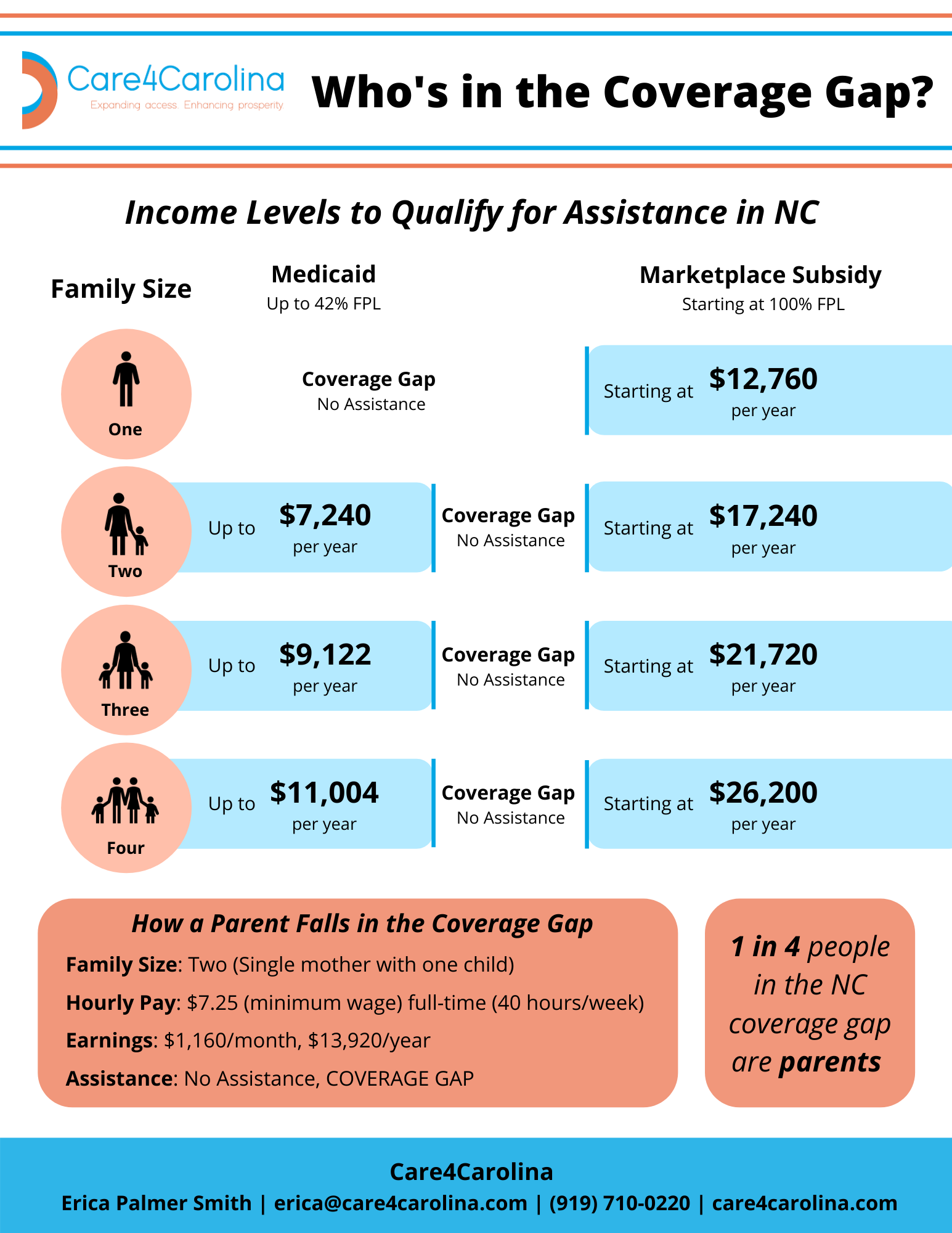
1 in 4 people in the coverage gap are parents. Not all low-income parents qualify for Medicaid. Currently in North Carolina, a parent can only qualify for Medicaid if they earn up 42% of the federal poverty line. This means that a single mother with one child that earns more than $7,240 per year cannot qualify for Medicaid.
Eligibility for marketplace subsidies does not kick-in until a parent earns 100% of the federal poverty line, or $17,240 per year for a single mother with one child. So, if that single mother’s income falls between $7,240 and $17,240 per year, she has no assistance in gaining health coverage.
North Carolinians are clearly suffering because of the state’s failure to close the coverage gap up to this point. We can do more than just offer words of appreciation to our frontline workers and sympathy for the parents struggling to make ends meet. We can act to protect the people that help North Carolina grow and prosper. We need to make 2021 the year that North Carolina closes the health insurance coverage gap.